

Ecommerce website development in Pakistan
Still taking orders in your DMs?
Noviq IT Solutions builds custom ecommerce solutions for B2B and B2C brands in Pakistan. Your customers pay online or on delivery, get a confirmation by email and SMS, and track their parcel. Every order lands in your admin panel, with the customer's address already on it.
Complete store: PKR 230,000
Every proposal includes a free competitor analysis. Already have a website? We audit it free too. Both are yours to keep, whatever you decide.
- Registered with the SECPCUIN 0351640
- Registered with the PSEBZ-25-21853/26
- Building 55, 1st Floor, R-3 Block, Phase 2 Johar Town, Lahore, 54000, Pakistan (opens in a new tab)
What does a Noviq online store include?
A complete Noviq store has six parts: a custom design, up to 50 products at launch, payments, a courier connection, order emails and SMS, and an admin panel. All six together cost PKR 230,000. Don't need a part? We leave it out, and the price comes down. Your proposal confirms the exact list and price.
Your own design
A custom design for your brand, with a 3D section at the top of your homepage. You approve the design before we build.
Up to 50 products at launch
Product pages built from the photos, descriptions and categories you send us, with options such as size and colour. Selling more than 50? Your proposal prices the extra products.
Payments
We connect your payment gateway. Depending on the gateway, customers can pay by card, bank account or mobile wallet. You can also offer cash on delivery.
Courier connection
We connect your store to your courier's system, so tracking updates appear on each order and customers can follow their parcel. If you'd like, your store can also book parcels with the courier automatically.
Order emails and SMS
Customers get an order confirmation by email and SMS as soon as they order.
Your admin panel
Add and edit products, prices and stock, and manage every order, from one place.
Every store also has a WhatsApp button that opens with a ready-written message, a contact form, your Google Maps location and links to your social pages.
Can I see an online store Noviq has built?
Yes. We built two demo stores to show how our stores look and work. Neither is a client's store, and neither takes real orders. Alpha Clothing takes you from the shop to the checkout. Atelier Crimsøn is a one-product store that shows what a 3D section at the top of your homepage can look like.
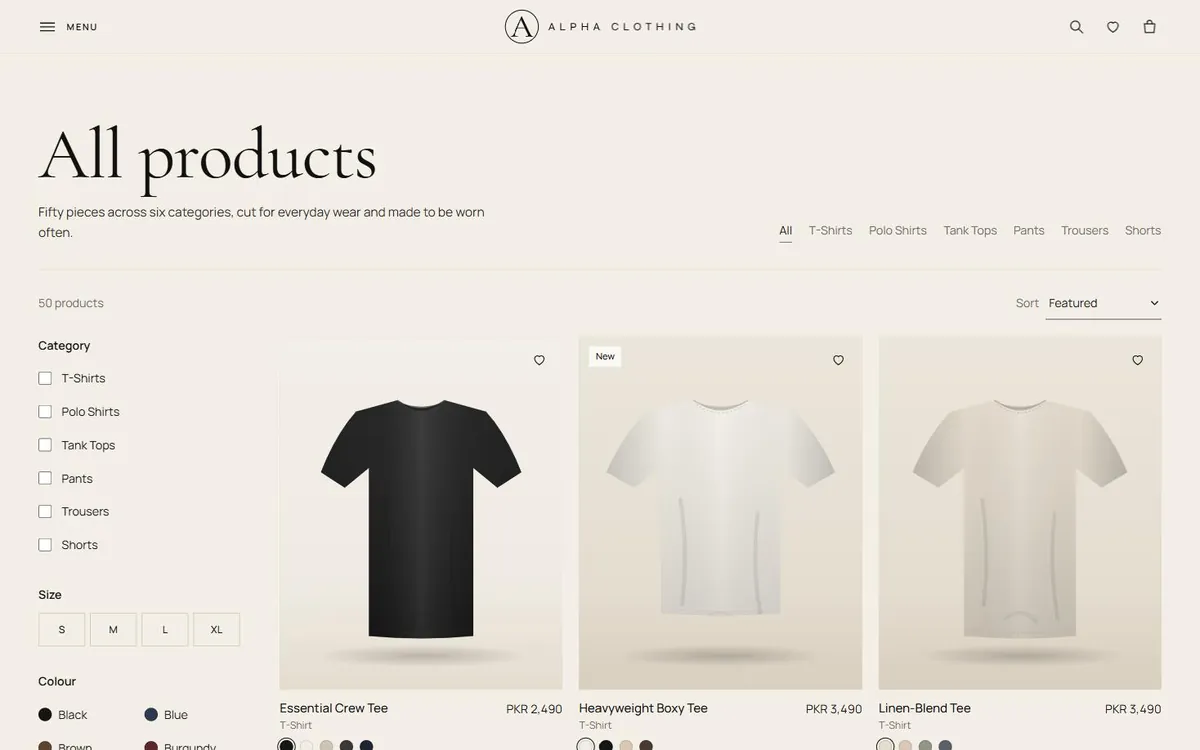
DEMO STORE · MENSWEAR
Alpha Clothing
- A homepage where each garment turns towards you as you point at it
- 50 products in six categories, with filters for size, colour and price
- A colour and size choice on every product page
- A bag that shows the delivery charge before checkout
- A checkout with cash on delivery and no account needed
- An order-tracking page
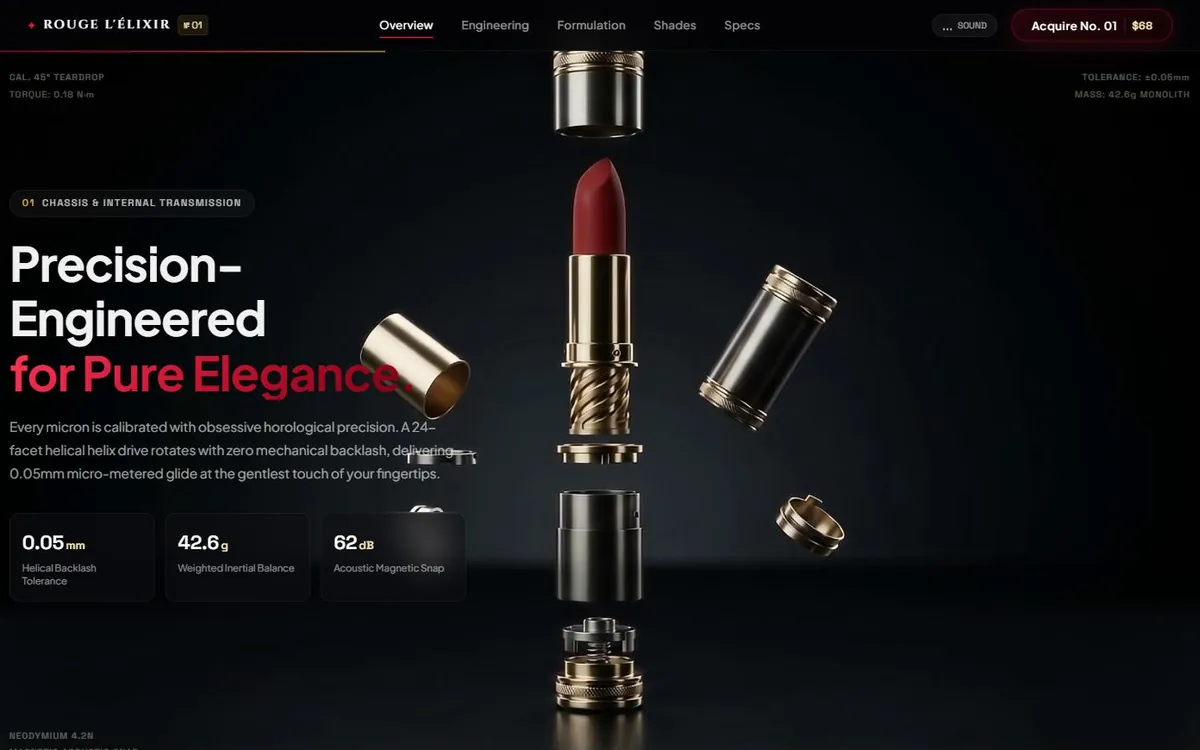
DEMO STORE · BEAUTY
Atelier Crimsøn
- A 3D lipstick that comes apart as you scroll, then comes back together
- Four shades, each with its own description
- A buy button that stays at the top of the screen
- An order panel where you add a monogram and see the total
What happens when a customer orders?
Your store handles each order in the same few steps, whether the customer pays on delivery or online. Here are two orders, start to finish.
Example 1: Cash on delivery
- A customer in Multan orders two shirts on her phone and chooses cash on delivery.
- She gets an order confirmation by email and SMS straight away.
- The order appears in your admin panel. You pack it and hand it to your courier.
- Tracking updates appear on the order, and the courier collects the cash at her door.
Example 2: Paid online
- A customer in Karachi orders a pair of shoes and pays by card.
- The payment gateway confirms the payment, and the order shows as paid in your admin panel.
- He gets an order confirmation by email and SMS straight away.
- You hand the parcel to your courier, and the customer tracks it until it reaches his door.
Why do shoppers leave before they pay?
In Baymard Institute's survey of US online shoppers (opens in a new tab), high extra costs, such as delivery charges, were the top reason for leaving at checkout.
70%
On average, about 7 in 10 online shopping carts are left without an order.
Baymard Institute, average of 50 studies, 2006 to 2025 (opens in a new tab)
Here are four common reasons, and how your checkout deals with each:
| Why shoppers left | How your checkout deals with it |
|---|---|
| Why shoppers leftExtra costs were too high, or the total was not shown up front | How your checkout deals with itThe full cost first. Delivery charges show in the cart, before the customer pays. |
| Why shoppers leftThey were asked to create an account | How your checkout deals with itNo account needed. Customers can order as guests. |
| Why shoppers leftThey did not trust the site with card details | How your checkout deals with itSecure, with other ways to pay. Every page uses a secure connection, and customers who would rather not use a card can choose cash on delivery, if you offer it. |
| Why shoppers leftThe checkout was too long or complicated | How your checkout deals with itA short checkout. Few fields, large buttons, and forms that fill in quickly on a phone. |
How fast will your online store load?
We agree speed targets with you before the build, and your store does not go live until it meets them in our tests. The targets cover:
- Main content on screen in 2.5 seconds or less, the level Google counts as good (opens in a new tab).
- Quick responses to taps and clicks.
- A layout that barely moves as the page loads.
8.4%
In a study of 37 brands carried out for Google, retail sites got 8.4% more orders from the same number of visits when their mobile pages loaded 0.1 seconds faster. Shoppers also spent 9.2% more.
How we keep your store fast:
- A content delivery network (CDN). Your store's images and files are served from servers close to each shopper.
- Built for phones first. Every page is designed for a small screen, then adapted for larger ones.
- Still image first, 3D after. The 3D section on your homepage first loads as a still image, so the page appears quickly even on a weak mobile signal. The animation loads after that.
Measured on our homepage: Our own website goes through the same tests. We checked our homepage with Google PageSpeed Insights on 10 November 2026. Its main content appeared in 1.0 second on mobile and 0.6 seconds on desktop.
1.0 s
Mobile
0.6 s
Desktop
Good: 2.5 s or less
Main content on screen (LCP) · lab test, Google PageSpeed Insights, 10 November 2026
Will your store be ready for Google and AI search from day one?
Yes. Every store we build includes SEO and AI search foundations from the start. Adding them after launch can mean rebuilding pages or changing page addresses, and Google warns (opens in a new tab) that big changes to a site can make its rankings rise and fall for a while.
Your store comes with these foundations:
- A page and a readable address for every product. Each product, category and option, such as a size or colour, gets its own address with real words in it, as Google's guide for online stores (opens in a new tab) recommends.
- Product details shared with Google. Structured data on each product page tells Google the product's name, price and availability. Google says (opens in a new tab) this can make your products eligible to show their price and availability in search results. We also set up Google Merchant Center, which Google requires for listings in its Shopping tab (opens in a new tab).
- Fast pages on every screen. Google recommends a good page experience for its AI answers (opens in a new tab) too.
- Data from the first day. Google Analytics 4 and Google Search Console, so you can see how shoppers find your store and which pages Google has indexed.
SEO and AI search optimisation can start on these foundations the day your store goes live.
How do you keep your store safe and online?
We protect every store from common attacks and prepare it for busy days, such as the start of a sale. No one can promise that a website will never be attacked, so while your store is in our care, we keep watching it and keep it up to date.
53%
In 2025, more than 53% of all web traffic came from bots, not people. Some are welcome, such as search engines; others try to break into accounts.
Protection from attacks
- A secure connection on every page. SSL encrypts what customers type, such as their address and phone number.
- Card details stay with your payment gateway. Customers type them on the gateway's secure page, so your store never stores card numbers.
- A separate login for each staff member. Each login has two-step verification and opens only the parts of the admin panel that person needs.
- Locked down before launch. We remove the usual weak spots in settings and code, then test the store's security against the targets agreed with you.
- Spam and bot protection. Your forms, logins and checkout turn away spam and harmful bots.
- Updates and backups. We apply security updates and keep regular backups, so a problem can be fixed and your data restored.
Ready for busy days
- Pages ready before the rush. Product and category pages are built ahead and served from the CDN, so a jump in visitors doesn't overload your store's server.
- A check before every big sale. Tell us the date, and we test the store beforehand and raise your hosting limits for the day if needed.
- Alerts if the store goes down. We're alerted if your store stops responding, and we act on it.
How does ecommerce website development with Noviq work?
Most stores take 5 to 7 weeks to build, with 4 rounds of changes included before launch. You approve each stage before we move to the next.
- A short call. We learn about your products, your customers and how you deliver.
- Your proposal. Within 2 working days, you receive our written proposal. It holds the competitor analysis, an audit of your current site if you have one, the scope, a roadmap and your price.
- A design to approve. We design your store and build a clickable version of the main pages. You get 2 rounds of changes before any code is written.
- The pages your customers see. We build the front of the store and show it to you, with 1 round of changes.
- Payments, delivery and your admin panel. We build the back of the store: the database, the admin panel, the order emails and SMS, and the connections to your payment gateway and your courier.
- Testing and your review. We test orders, payments, tracking, speed and security against the agreed targets. Then you review the finished store, with 1 round of changes.
- Launch and handover. Your store goes live, we show your team how to use the admin panel, and we stay on to look after it.
What do you need to prepare?
Six things from you keep the build on time. Our delivery times assume each one reaches us before the step shown.
Before step 3:
- Your brand. Your logo, your colours and a few stores you like the look of.
- Product details. Photos, descriptions, prices and categories for each product. We can write the descriptions as a separate paid service.
Before step 5:
- A payment gateway account in your business's name. Apply early: your store can't take online payments until the gateway approves your business.
- Your courier account and API access. Your courier provides the access that lets your store connect to its system.
- A domain and hosting in your name. You pay the providers directly for these, and for charges such as gateway fees, SMS and a paid database if your store needs one.
- Links to your social pages.
You own what you pay for. We hand over your store's files and logins at launch.
Who will build your store?
You work directly with the founders, supported by our specialists.

Muhammad Abdullah
Co-founder & CEO
Leads the company: its strategy, its client engagements and the delivery standards every project must meet.

Adnan Allah Ditta
Co-founder & CTO
Leads engineering: the build, the connections to your payment gateway and courier, and the technical checks before launch.
Our SEO specialist
SEO & AI search
Checks that every page is ready for Google and AI search before launch.
Ecommerce website development in Pakistan: questions store owners ask
Most online stores take 5 to 7 weeks, including 4 rounds of changes before launch. That time assumes your product photos, details and feedback reach us on time. Online payments can only go live once your payment gateway approves your account.
A complete store with every feature on this page costs PKR 230,000: a custom design with a 3D section on your homepage, up to 50 products loaded for you, payments, a courier connection, order emails and SMS, and your admin panel. Leave out what you don't need, and the price comes down. Prices exclude tax, and you pay your domain, hosting, gateway and SMS charges directly. Your exact price comes in a written proposal within 2 working days of our first call. Our guide to website costs in Pakistan explains each factor.
Cash on delivery, plus online payments through a payment gateway. Online, Pakistani shoppers mostly pay from mobile wallets and bank accounts: the State Bank of Pakistan reports (opens in a new tab) that these made up almost 96% of e-commerce payments processed by banks in the year to June 2026. So we suggest a gateway that takes wallets, bank accounts and cards together, such as PayFast or Safepay; JazzCash and Easypaisa also run their own. Payment companies usually approve faster than banks. Have your CNIC or company papers, NTN and a business bank account ready.
Popular couriers for online stores in Pakistan include PostEx, TCS, Leopards, Trax and M&P. If most of your orders are cash on delivery, compare how fast each courier pays you the cash it collects: PostEx offers upfront payment on COD orders (opens in a new tab), while traditional couriers can take 10 to 15 days or longer. Trax is strong for same-city delivery (opens in a new tab) in big cities. We connect your courier through its API, so tracking updates appear on each order, and your store can also book parcels automatically if you'd like. Your proposal confirms the connection.
Yes. From your admin panel you can add products, change prices, update stock and manage orders, without touching code. We show your team how before handover. The first month of care after launch is free; after that, our monthly store care plan includes updates to up to 10 products a month, if you would rather we made them.
Your store can appear on Google, but no one can guarantee where it ranks. Every store we build loads fast on phones, uses a secure connection, labels its products for Google and comes with Google Analytics 4 and Google Search Console. We also set up Google Merchant Center, which Google requires for its Shopping tab. Ranking for competitive searches takes ongoing work, which our SEO services page explains.
We usually build online stores with React and Next.js, two widely used, well-supported frameworks. Each store has its own database and an admin panel made for your products and orders. We suggest the database, like the rest of the technology, once we understand what your store must do and who will run it. For example, Supabase's free plan (opens in a new tab) has room for a small store's products and orders, and its paid plan adds daily backups and more space.
Yes. We are headquartered in Lahore and build stores for businesses anywhere in the world. Calls, design reviews and progress demos happen online, in English or Urdu.
Ask us anything.
Tell us about your store
Share a few details and we'll reply on WhatsApp within 30 minutes, between 11 AM and 11 PM Pakistan time (UTC+5).
What happens next
- A WhatsApp reply within 30 minutes (11 AM to 11 PM, Pakistan time), then a short call about your business.
- Your proposal within 2 working days: competitor analysis, an audit of your current site if you have one, a roadmap and your price.
- A design to approve before we build anything.
Prefer to talk now? Call or WhatsApp +92 307 6669222, or visit us at Building 55, 1st Floor, R-3 Block, Phase 2 Johar Town, Lahore, 54000, Pakistan.
Once your store is live, we can also bring shoppers to it with Meta ads and Google Ads, and track your sales in Power BI dashboards for retailers. See how we work with retailers and online stores, or read about our web development services for business websites and web applications.
Sources
- Baymard Institute: cart abandonment rate (opens in a new tab): average of 50 studies, and reasons for leaving at checkout
- web.dev: Milliseconds make millions (opens in a new tab): 55 and Deloitte for Google, 2020
- web.dev: Web Vitals (opens in a new tab)
- Google Search Central: URL structure for ecommerce sites (opens in a new tab) and Product structured data (opens in a new tab)
- Google Search Central: sharing product data with Google (opens in a new tab): Merchant Center and the Shopping tab
- Google Search Central: optimising for generative AI features (opens in a new tab) and how to move a site (opens in a new tab)
- State Bank of Pakistan: Annual Payment Systems Review FY26 (opens in a new tab): how e-commerce payments are made
- XStak: courier services for e-commerce in Pakistan, 2026 (opens in a new tab): how fast couriers pay out cash on delivery
- HypeUp: courier integrations in Pakistan compared, 2026 (opens in a new tab): same-city delivery in big cities
- Supabase: pricing (opens in a new tab): what the free and paid database plans include
- Imperva: Bad Bot Report 2026 (opens in a new tab): how much web traffic comes from bots